
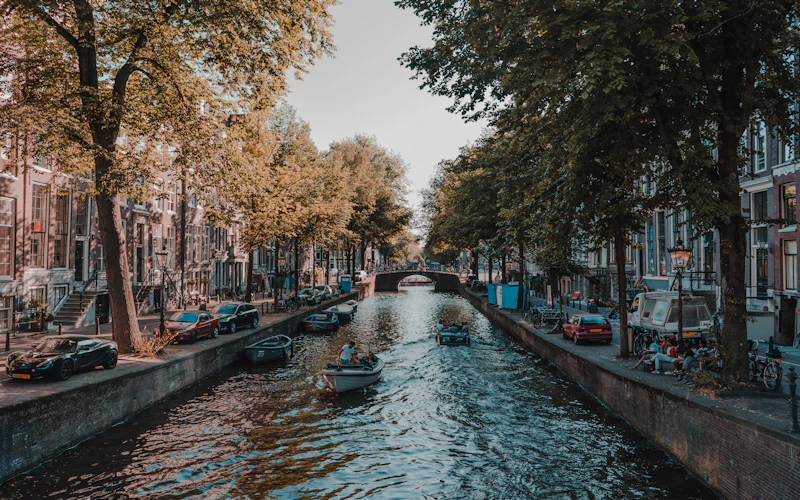
Why study in Netherlands?
The Netherlands has many bachelor's and master's courses taught fully in English, at research universities and universities of applied sciences. It suits Indian students who want an English-taught European degree.
Non-EU students pay an institutional fee. Study in NL gives typical ranges of €9,000–20,000 a year for a bachelor's and €12,000–30,000 for a master's. Your university applies for your residence permit as a recognised sponsor, and you must show €1,130.77 a month for living costs (2026).
After graduating, you can apply for a 1-year orientation year permit. During that year you can work freely, and employers can hire you at a lower salary threshold as a highly skilled migrant.
- Many bachelor's and master's courses taught fully in English
- Your university applies for your residence permit for you
- A 1-year orientation year permit after graduating, with free access to the job market
- A lower highly skilled migrant salary threshold for recent graduates (€3,122 a month gross in 2026)
- Work up to 16 hours a week, or full-time in June, July and August
- Scholarships such as the NL Scholarship for non-EEA students
Popular universities in Netherlands
Delft University of Technology (TU Delft)
Delft · English-taught MSc in Computer Science and AI
Erasmus University Rotterdam
Rotterdam · Home to Rotterdam School of Management (RSM)
University of Amsterdam
Amsterdam · Amsterdam Merit Scholarship for non-EU bachelor's
University of Groningen
Groningen · English-taught BSc Computing Science
Maastricht University
Maastricht · English-taught bachelor's in business and data
Utrecht University
Utrecht · February and September master's intakes
University of Twente
Enschede · Participates in the NL Scholarship (2026–27)
Wageningen University & Research
Wageningen · English-taught MSc Food Technology
Popular programmes
- Computer Science
- Data Science & AI
- Business Analytics
- Management
- Econometrics
- Engineering
- Food Technology
- Hospitality Management
Courses from our Course Finder
MSc Computer Science
Delft University of Technology (TU Delft) · Delft · Master’s · 2 years
MSc Data Science and Artificial Intelligence Technology
Delft University of Technology (TU Delft) · Delft · Master’s · 2 years
MScBA Master in Management
Erasmus University Rotterdam (Rotterdam School of Management) · Rotterdam · Master’s · 12 months
International Full-time MBA
Erasmus University Rotterdam (Rotterdam School of Management) · Rotterdam · MBA · 12 months
International Bachelor Econometrics and Operations Research
Erasmus University Rotterdam · Rotterdam · Bachelor’s · 3 years
Computing Science (BSc)
University of Groningen · Groningen · Bachelor’s · 3 years
Cost of studying: financial breakdown
| Expense | Amount |
|---|---|
| Undergraduate tuition | €9,000–20,000 / yrTypical institutional fee for non-EU students |
| Postgraduate tuition | €12,000–30,000 / yrTypical institutional fee; MBAs cost more |
| Living costs / proof of funds | €1,130.77 / monthIND requirement for university and HBO students, 2026 |
| Residence permit fee | €254Paid through your institution |
| Application fee | €75–100Charged by some institutions to non-EEA applicants |
| Health insurance | About €133 / monthBasic Dutch health insurance if you work in the Netherlands (Nibud 2024 average) |
| Rent | €450–1,000 / monthAverage room; Nibud 2024 average €561 |
Typical tuition in rupees: ≈ ₹10–33 lakh per year (European Central Bank and Bank of Russia reference rates, 9 October 2026).
Application checklist
- 1Valid passport
- 2Admission to an accredited, full-time course at an IND-recognised sponsor
- 3English test score (IELTS, TOEFL or Cambridge) as required by your course
- 4Degree certificates and mark sheets (and application fee if your university charges one)
- 5Proof of funds of €1,130.77 a month (2026)
- 6Residence permit fee of €254, paid through your institution
- 7Book your MVV visa appointment within 3 months of the IND decision
- 8TB test after arrival, if your institution says you need one
- 9Plan to earn at least 50% of your credits each year to keep your permit
Student visa: MVV and residence permit for study
Indian students need a provisional residence permit (MVV) and a residence permit for study. Your university, as an IND-recognised sponsor, applies for you after you are admitted. The IND decides within 60 days, and you then collect the MVV at the Dutch embassy or consulate.
What you’ll need
- Admission to a course at an IND-recognised sponsor, which files the application
- Proof of funds of €1,130.77 a month (2026)
- Application fee of €254
- Valid passport
- MVV appointment within 3 months of the decision
- TB test if your institution indicates one
- Study progress of at least 50% of credits each year
Processing time: The IND must decide within 60 days; this can be extended.
Work and employment options
- While you study
- Up to 16 hours a week, or full-time in June, July and August; your employer needs a work permit (TWV) for you
- After you graduate
- Orientation year permit for highly educated persons: valid for 1 year, for graduates who completed a Dutch bachelor's or master's in the last 3 years. You can work freely during this year without a TWV. Employers can then hire you as a highly skilled migrant at the reduced salary threshold (€3,122 a month gross in 2026).
- The orientation year gives you 12 months of free access to the Dutch job market
- Recent graduates qualify for a lower highly skilled migrant salary threshold (€3,122 a month gross in 2026)
- The reduced EU Blue Card threshold for recent graduates is €4,754 a month gross (2026)
- You can apply for the orientation year within 3 years of graduating
Good to know: Your employer needs a TWV work permit before you can take a job, and you must earn at least 50% of your credits each year to keep your residence permit.
Scholarships to explore
- NL Scholarship: €5,000 in the first year for non-EEA students at participating institutions
- Amsterdam Merit Scholarship (University of Amsterdam): €6,000 a year for non-EU bachelor's students
- University scholarships (check each university's scholarship finder)
Official sources · checked 10 October 2026
- IND: student residence permit for university or higher professional education (opens in a new tab)
- IND: required amounts and income requirements (opens in a new tab)
- IND: residence permit for orientation year (opens in a new tab)
- Study in NL: tuition fees (opens in a new tab)
- Study in NL: cost of living (opens in a new tab)
- Study in NL: NL Scholarship (opens in a new tab)
Figures are indicative planning ranges and change often. Always confirm fees, funds and visa rules on the university and official government websites before you apply.